

Open the app and start moving
WikiTrip uses your location to find the most interesting Wikipedia articles within walking, driving, or cycling distance.
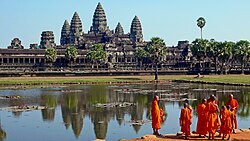
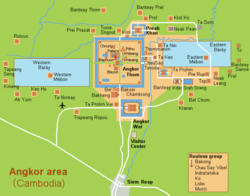
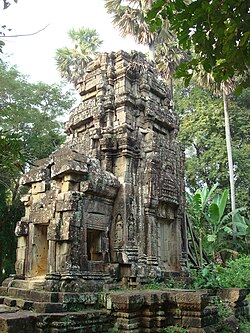
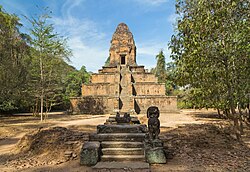
Angkor Wat (; Khmer: អង្គរវត្ត, 'City/Capital of Temples') is a Vaishnava Hindu and Theravada Buddhist temple complex in Siem Reap, Cambodia, and the largest religious complex in the world. Located on a site measuring 162.

6 hectares (1.6 km2; 401.8 acres) within the ancient capital of Angkor, it was constructed between 1113 and 1150 CE during the reign of the Khmer king Suryavarman II as a Hindu temple dedicated to Vishnu. From the late 13th century onward, the complex was gradually transformed into a Buddhist temple and has remained an active center of Buddhist worship for centuries. Angkor Wat is noted for its monumental scale, extensive bas-reliefs, and architectural unity characteristics of Khmer architecture. Unlike most Angkorian temples, it is oriented toward the west. It is a symbol of Cambodia and appears on the Cambodian national flag.
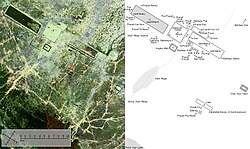
The temple was commissioned by Suryavarman II in Yaśodharapura, the capital of the Khmer Empire, as a state temple and is generally considered to have been intended as his mausoleum. Its architectural design combines the temple-mountain and galleried temple forms characteristic of Khmer architecture. The overall layout is commonly interpreted as a symbolic representation of Mount Meru, a cosmological concept shared by both Hindu and Buddhist traditions. The complex is surrounded by a broad moat and enclosed by an outer wall, within which three progressively elevated galleries rise toward a central quincunx of towers.
Ancient sites can be hard to read from the stones alone. WikiTrip narrates what once stood here as you move through the ruins, turning weathered foundations back into living places.
As you walk near Angkor Wat, WikiTrip automatically surfaces the most relevant Wikipedia stories within a few minutes' walk — no searching required.
WikiTrip uses your location to find the most interesting Wikipedia articles within walking, driving, or cycling distance.
A natural AI voice reads the article aloud. Choose from 13 expressive voices in 19 languages with Premium.
Background audio, lock-screen controls, and Bluetooth support. Every story is saved with a link to the full Wikipedia page.
WikiTrip works anywhere on Earth with nearby Wikipedia articles — not just here. Free to download, with 13 expressive voices in 19 languages on Premium.

Intro and nearby points of interest sourced from Wikipedia, licensed under CC BY-SA 4.0.