

Open the app and start moving
WikiTrip uses your location to find the most interesting Wikipedia articles within walking, driving, or cycling distance.
Neuschwanstein Castle (German: Schloss Neuschwanstein, pronounced [ˈʃlɔs nɔʏˈʃvaːnʃtaɪn]; Southern Bavarian: Schloss Neischwanstoa; lit. 'Newswanstone') is a 19th-century historicist palace on a rugged hill of the foothills of the Alps in the very south of Germany, near the border with Austria.
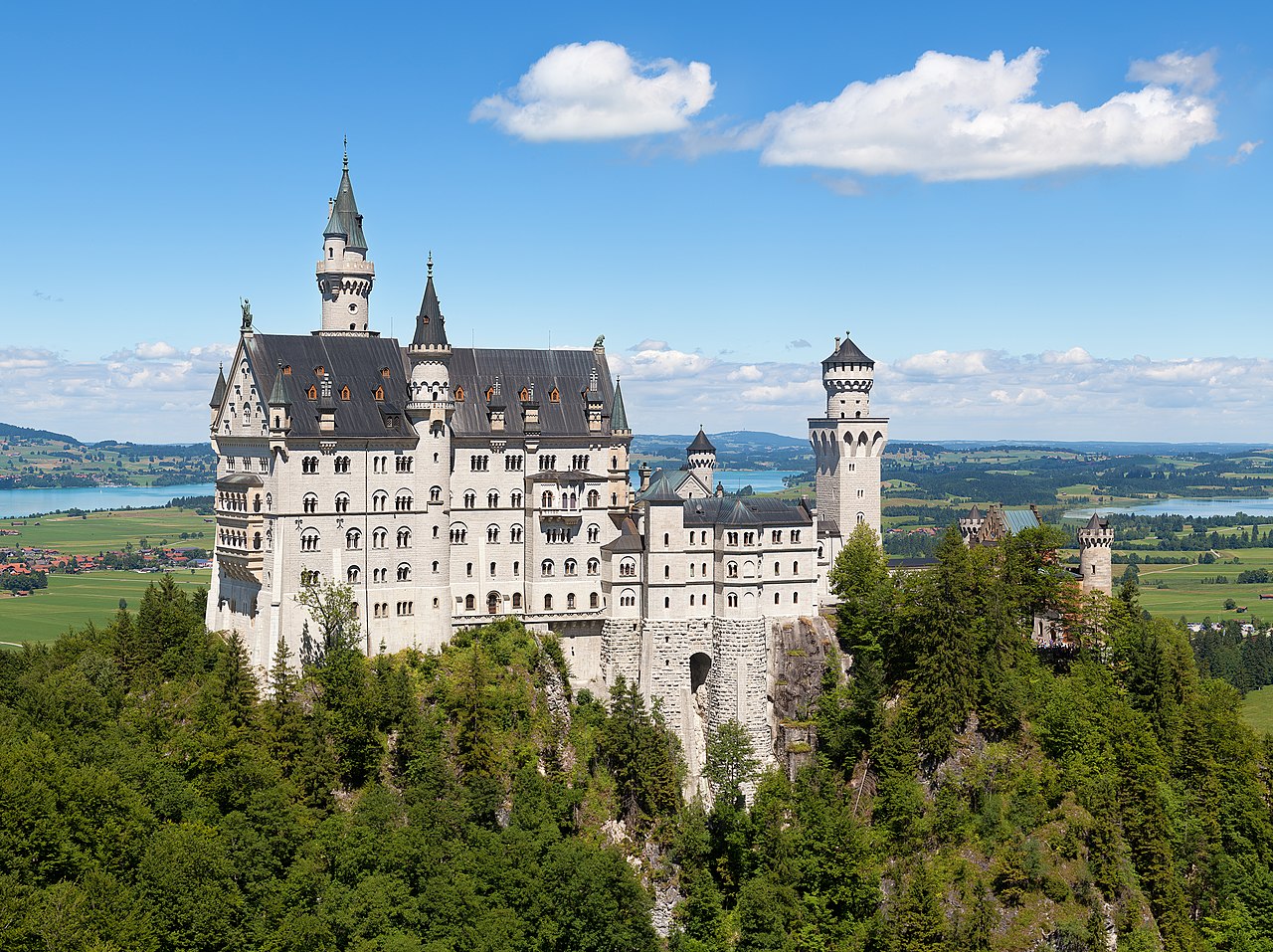
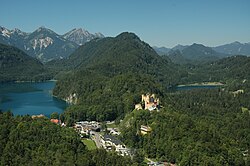
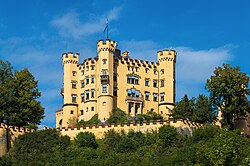
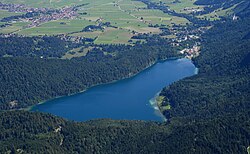
It is located in the Swabia region of Bavaria, in the municipality of Schwangau, above the incorporated village of Hohenschwangau, which is also the location of Hohenschwangau Castle. The closest larger town is Füssen. The castle stands above the narrow gorge of the Pöllat stream, east of the Alpsee and Schwansee lakes, close to the mouth of the Lech into Lake Forggensee. Since 2025, the castle is part of the UNESCO World Heritage Site "The Palaces of King Ludwig II of Bavaria: Neuschwanstein, Linderhof, Schachen and Herrenchiemsee". According to Guinness World Records, at 65 metres (213 feet), it is the tallest castle in the world.
Despite the main residence of the Bavarian monarchs at the time—the Munich Residenz—being one of the most extensive palace complexes in the world, King Ludwig II of Bavaria felt the need to escape from the constraints he saw himself exposed to in Munich, and commissioned Neuschwanstein Castle on the remote northern edges of the Alps as a retreat but also in honour of composer Richard Wagner, whom he greatly admired. The three-winged complex was built between 1869 and 1892 based on plans by Eduard Riedel in the Neo-Romanesque style. Medieval knights' castles served as its architectural model. The throne room, the bedroom, and the minstrels' hall are particularly noteworthy.
Landmarks like this reward slow exploration. With WikiTrip in your pocket, the history unfolds in your ears as you walk up — no guidebook, no screen, just the story of what you're looking at.
As you walk near Neuschwanstein Castle, WikiTrip automatically surfaces the most relevant Wikipedia stories within a few minutes' walk — no searching required.

WikiTrip uses your location to find the most interesting Wikipedia articles within walking, driving, or cycling distance.
A natural AI voice reads the article aloud. Choose from 13 expressive voices in 19 languages with Premium.
Background audio, lock-screen controls, and Bluetooth support. Every story is saved with a link to the full Wikipedia page.
WikiTrip works anywhere on Earth with nearby Wikipedia articles — not just here. Free to download, with 13 expressive voices in 19 languages on Premium.

Intro and nearby points of interest sourced from Wikipedia, licensed under CC BY-SA 4.0.