
.jpg)
Open the app and start moving
WikiTrip uses your location to find the most interesting Wikipedia articles within walking, driving, or cycling distance.
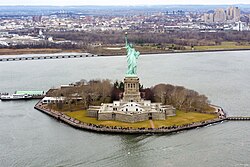
The Statue of Liberty (Liberty Enlightening the World; French: La Liberté éclairant le monde) is a colossal neoclassical sculpture of a robed and crowned woman on Liberty Island, part of New York City, in New York Harbor. The copper-clad statue, a gift to the United States from the people of France, was designed by French sculptor Frédéric Auguste Bartholdi, and its metal framework built by Gustave Eiffel.
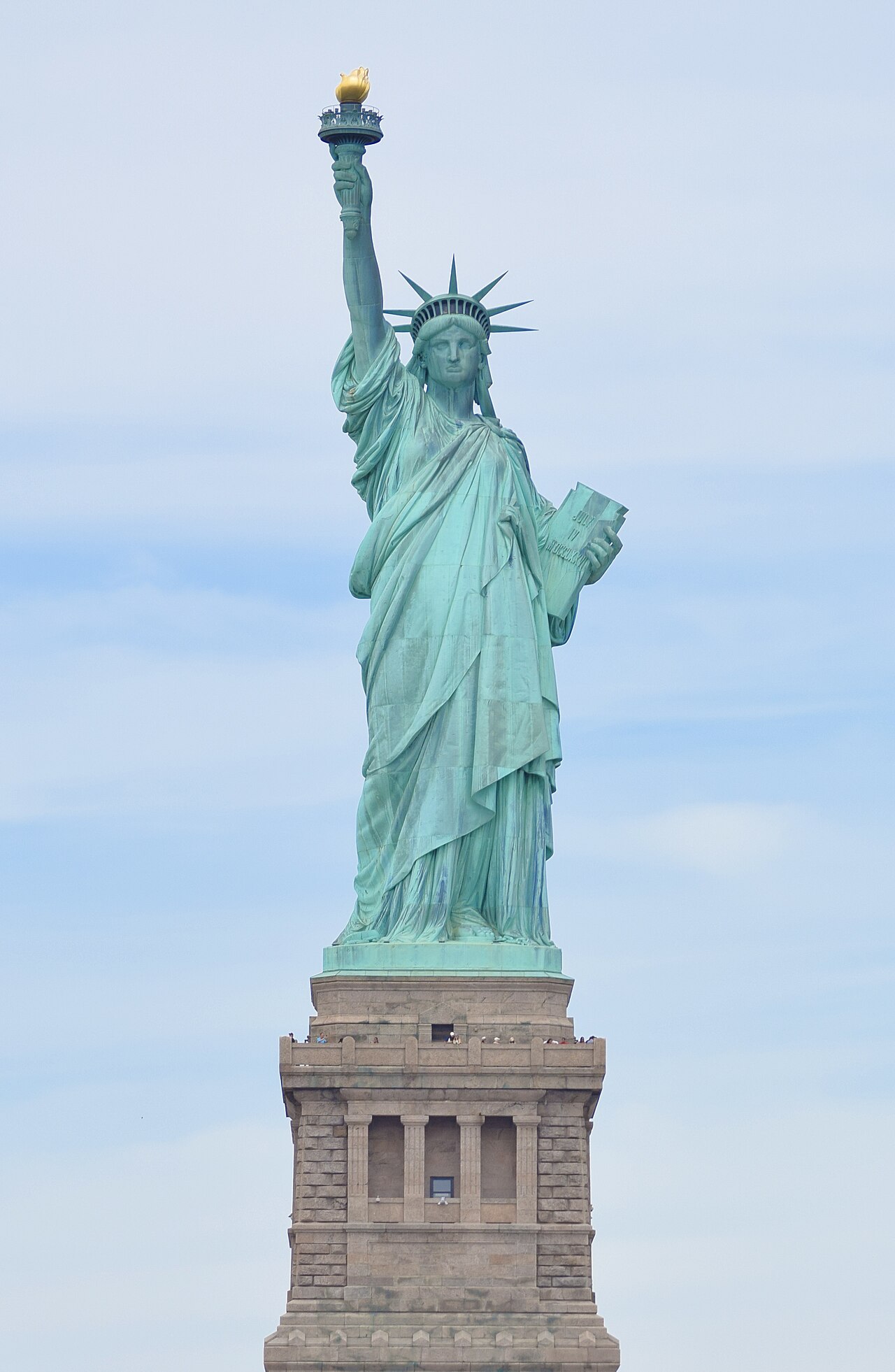
The statue was dedicated on October 28, 1886.
The statue is a figure of a classically draped woman, inspired by the Roman goddess of liberty, Libertas. She holds a torch above her head with her right hand, and in her left hand carries a tabula ansata inscribed JULY IV MDCCLXXVI (July 4, 1776, in Roman numerals), the date of the U.S. Declaration of Independence. With her left foot she steps on a broken chain and shackle, commemorating the national abolition of slavery following the American Civil War.
In 1865, the French historian and abolitionist Édouard de Laboulaye proposed a monument to commemorate the upcoming centennial of U.S. independence (1876), the perseverance of American democracy and the liberation of the nation's slaves. The Franco-Prussian War delayed progress until 1875, when Laboulaye proposed that the people of France finance the statue and the United States provide the site and build the pedestal. Bartholdi completed the head and the torch-bearing arm before the statue was fully designed, and these pieces were exhibited for publicity at international expositions. The torch-bearing arm was displayed at the Centennial Exposition in Philadelphia in 1876, and in Madison Square Park in Manhattan from 1876 to 1882. Fundraising proved difficult, especially for the Americans; publisher Joseph Pulitzer of the New York World started a drive for donations to finish the project. The statue was built in France, shipped overseas in crates, and assembled on the completed pedestal on what was then called Bedloe's Island. The statue's completion was marked by New York's first ticker-tape parade and a dedication ceremony presided over by President Grover Cleveland.
Landmarks like this reward slow exploration. With WikiTrip in your pocket, the history unfolds in your ears as you walk up — no guidebook, no screen, just the story of what you're looking at.
As you walk near Statue of Liberty, WikiTrip automatically surfaces the most relevant Wikipedia stories within a few minutes' walk — no searching required.

WikiTrip uses your location to find the most interesting Wikipedia articles within walking, driving, or cycling distance.
A natural AI voice reads the article aloud. Choose from 13 expressive voices in 19 languages with Premium.
Background audio, lock-screen controls, and Bluetooth support. Every story is saved with a link to the full Wikipedia page.
WikiTrip works anywhere on Earth with nearby Wikipedia articles — not just here. Free to download, with 13 expressive voices in 19 languages on Premium.

Intro and nearby points of interest sourced from Wikipedia, licensed under CC BY-SA 4.0.