
.jpg)
Open the app and start moving
WikiTrip uses your location to find the most interesting Wikipedia articles within walking, driving, or cycling distance.
The Eiffel Tower ( EYE-fəl; French: Tour Eiffel [tuʁ ɛfɛl] ) is a lattice tower on the Champ de Mars in Paris, France. It is named after the engineer Gustave Eiffel, whose company designed and built the tower from 1887 to 1889.
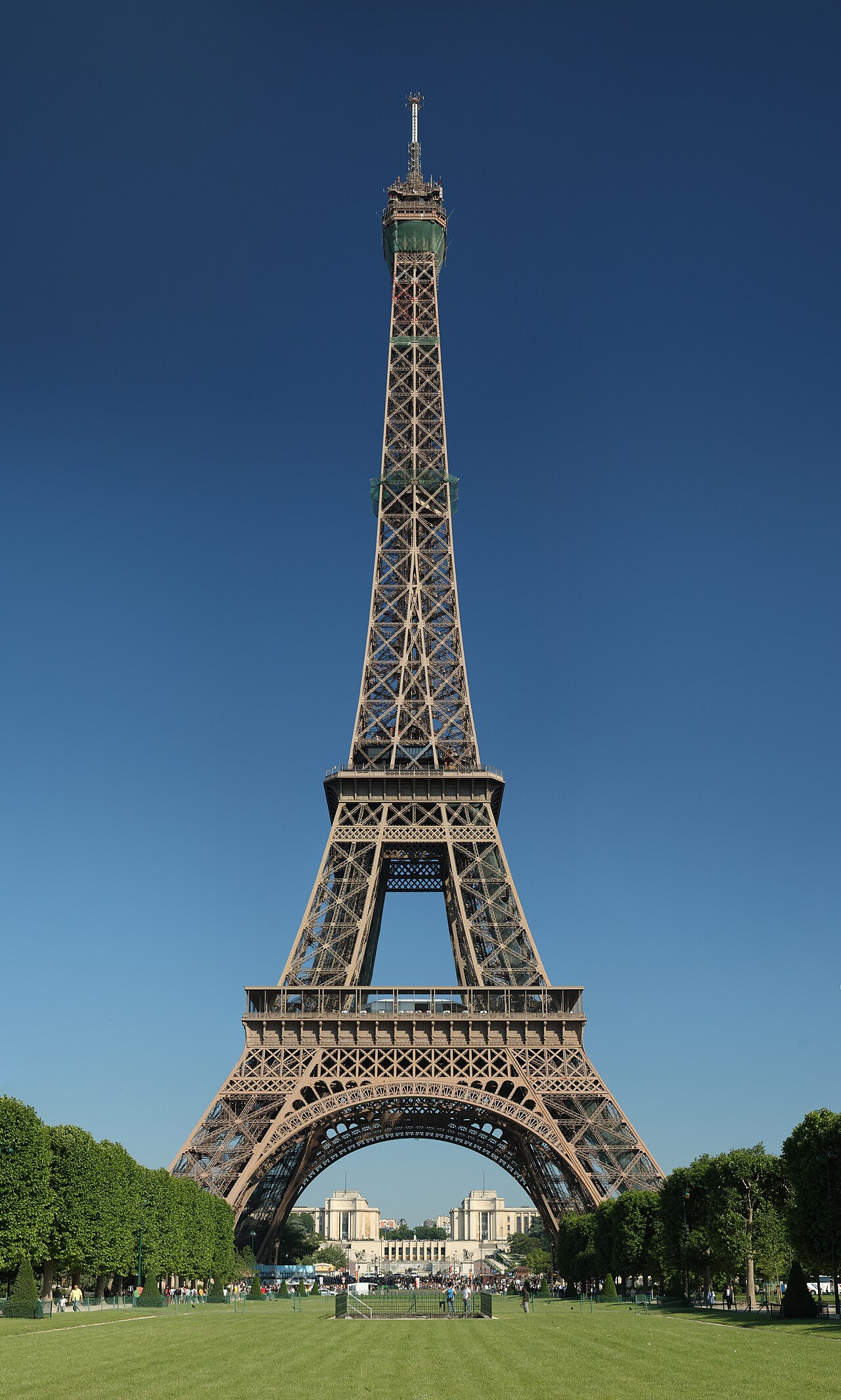
Locally nicknamed "La dame de fer" (French for "Iron Lady") for its use of wrought iron, it was constructed as the centrepiece of the 1889 World's Fair, and to crown the centennial anniversary of the French Revolution. Although initially criticised by some of France's leading artists and intellectuals for its design, it has since become a global cultural icon of France and one of the most recognisable structures in the world. The tower received 5,889,000 visitors in 2022. The Eiffel Tower is the most visited monument with an entrance fee in the world: 6.91 million people ascended it in 2015. It was designated a monument historique in 1964, and was named part of a UNESCO World Heritage Site ("Paris, Banks of the Seine") in 1991.
The tower is 330 metres (1,083 ft) tall, about the same height as an 81-storey building, and the tallest structure in Paris. Its base is square, measuring 125 metres (410 ft) on each side. During its construction, the Eiffel Tower surpassed the Washington Monument to become by far the tallest human-made structure in the world, a title it held for 41 years until the Chrysler Building in New York City was finished in 1930. It was the first structure in the world to surpass both the 200-metre and 300-metre mark in height. Due to the addition of a broadcasting aerial at the top of the tower in 1957, it is now taller than the Chrysler Building by 11 metres (36 ft). Excluding transmitters, the Eiffel Tower is the second tallest free-standing structure in France after the Millau Viaduct.
Landmarks like this reward slow exploration. With WikiTrip in your pocket, the history unfolds in your ears as you walk up — no guidebook, no screen, just the story of what you're looking at.
As you walk near Eiffel Tower, WikiTrip automatically surfaces the most relevant Wikipedia stories within a few minutes' walk — no searching required.
WikiTrip uses your location to find the most interesting Wikipedia articles within walking, driving, or cycling distance.
A natural AI voice reads the article aloud. Choose from 13 expressive voices in 19 languages with Premium.
Background audio, lock-screen controls, and Bluetooth support. Every story is saved with a link to the full Wikipedia page.
WikiTrip works anywhere on Earth with nearby Wikipedia articles — not just here. Free to download, with 13 expressive voices in 19 languages on Premium.

Intro and nearby points of interest sourced from Wikipedia, licensed under CC BY-SA 4.0.