
.jpeg)
Open the app and start moving
WikiTrip uses your location to find the most interesting Wikipedia articles within walking, driving, or cycling distance.
The Taj Mahal ( TAHJ mə-HAHL, TAHZH -; Hindustani: [t̪ɑːd͡ʒ ˈmɛɦ(ɛ)l]; lit. 'Crown of the Palace') is an ivory-white marble mausoleum on the right bank of the river Yamuna in Agra, Uttar Pradesh, India.
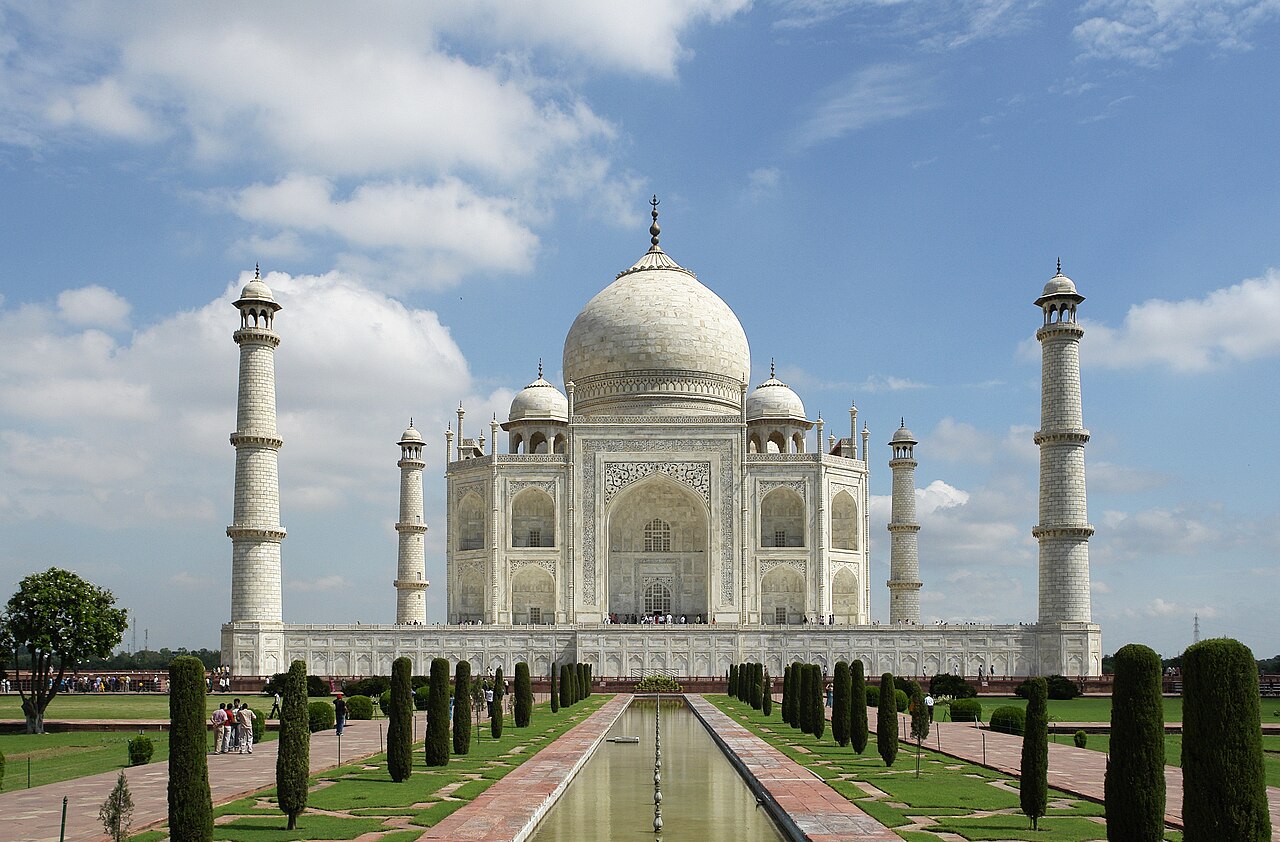
It was commissioned in 1631 by the fifth Mughal emperor, Shah Jahan (r. 1628–1658), to house the tomb of his beloved wife, Mumtaz Mahal; it also houses the tomb of Shah Jahan himself. The tomb is the centrepiece of a 17-hectare (42-acre) complex, which includes a mosque and a guest house, and is set in formal gardens bounded on three sides by a crenellated wall.
Construction of the mausoleum was completed in 1648, but work continued on other phases of the project for another five years. The first ceremony held at the mausoleum was an observance by Shah Jahan, on 6 February 1643, of the 12th anniversary of the death of Mumtaz Mahal. The Taj Mahal complex is believed to have been completed in its entirety in 1653 at a cost estimated at the time to be around ₹32 million, which in 2015 would be approximately ₹52.8 billion (US$827 million).
The building complex incorporates the design traditions of Indo-Islamic and Mughal architecture. It employs symmetrical constructions with the usage of various shapes and symbols. While the mausoleum is constructed of white marble inlaid with semi-precious stones, red sandstone was used for other buildings in the complex similar to the Mughal era buildings of the time. The construction project employed more than 20,000 workers and artisans under the guidance of a board of architects led by Ustad Ahmad Lahori, the emperor's court architect. The complex was designed and executed by a multinational board of artisans and supervisors, including Ottoman dome designer Ismail Afandi; Persian architects Ustad Isa, Isa Muhammad Effendi, and Puru; chief calligrapher Amanat Khan Shirazi; finial caster Qazim Khan; and masonry supervisors Muhammad Hanif, Mir Abdul Karim, and Mukkarimat.
Landmarks like this reward slow exploration. With WikiTrip in your pocket, the history unfolds in your ears as you walk up — no guidebook, no screen, just the story of what you're looking at.
As you walk near Taj Mahal, WikiTrip automatically surfaces the most relevant Wikipedia stories within a few minutes' walk — no searching required.

WikiTrip uses your location to find the most interesting Wikipedia articles within walking, driving, or cycling distance.
A natural AI voice reads the article aloud. Choose from 13 expressive voices in 19 languages with Premium.
Background audio, lock-screen controls, and Bluetooth support. Every story is saved with a link to the full Wikipedia page.
WikiTrip works anywhere on Earth with nearby Wikipedia articles — not just here. Free to download, with 13 expressive voices in 19 languages on Premium.

Intro and nearby points of interest sourced from Wikipedia, licensed under CC BY-SA 4.0.